Polar Embedding
#polar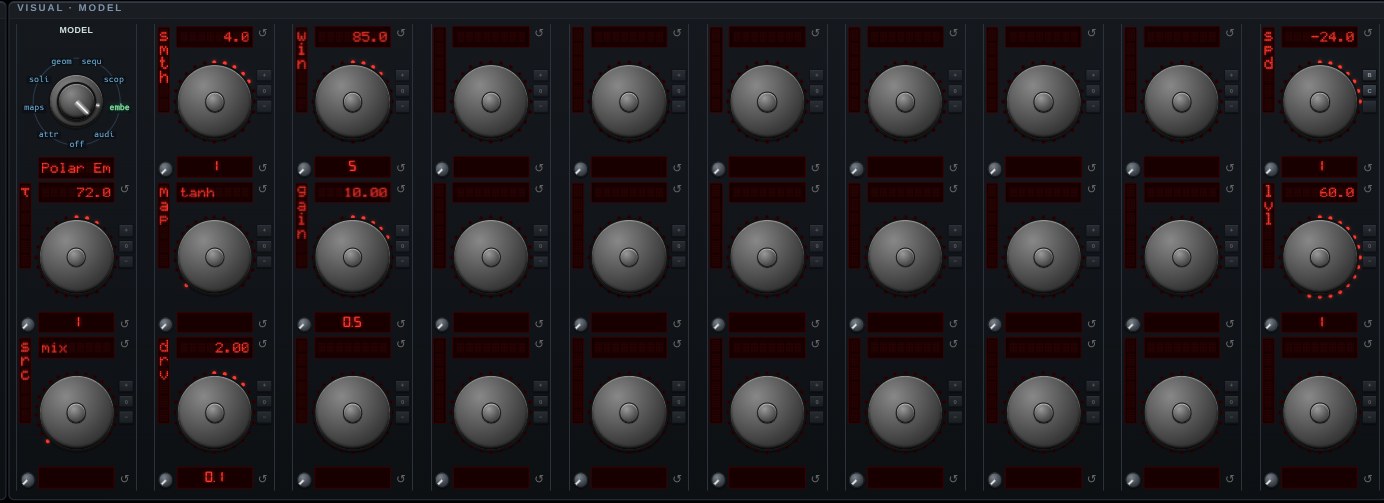
Polar Embedding — the Takens delay vector drawn in a sphere instead of a cube. The Takens mode plots (s(t), s(t−τ), s(t−2τ)) coordinate by coordinate, and each coordinate is one sample bounded to ±1 and multiplied by GAIN, so the reachable set is a cube: loud passages pile up against its faces and hardest of all against its corners, where all three coordinates peak together. That box is an artifact of writing the vector down in coordinates; nothing in the sound knows about the axes.
Here the vector is split into a direction and a length, the direction is kept exactly as it is, and only the length is passed through a curve that cannot exceed 1 — so the figure is bounded by a sphere, which looks the same from every angle, and no rotation finds an edge that is really the arithmetic showing through. The angles between successive delay vectors are untouched, which matters: those angles are the reconstructed geometry Takens' theorem is about, and a map that bent them would be drawing a different manifold.
MAP picks the curve. tanh is the soft clipper: near-linear when it is quiet, asymptotic to the surface when it is loud. Algebraic reaches the same surface more slowly, so the mid-range keeps more of its dynamics. Direction only throws the loudness away completely and puts every point on the surface — what is left is the angular motion the amplitude was hiding, so a figure that merely swelled and shrank before now moves. DRIVE is how hard the signal is pushed into the curve, and it does nothing on the direction-only position, where there is no length left to compress.
SRC picks which signal of the live pair is embedded, as in the Takens mode. τ and WIN mean exactly what they mean in the Takens mode, and the scale is fixed there too — nothing auto-ranges, so quiet draws small and loud draws large. The camera is fitted once to the sphere, which is the whole of what a bounded radius can reach, so peaks stay on screen without the room the cube's corner needed.
Audio comes from the active source — the microphone, a server feed, or the signal generators.
Open Polar Embedding in chaosrack →It opens running, on the model selector, with its own knobs. Rotate it by dragging, zoom with the wheel, and turn the parameters to see what the figure does when the system changes.