Stereo Embedding
#stereo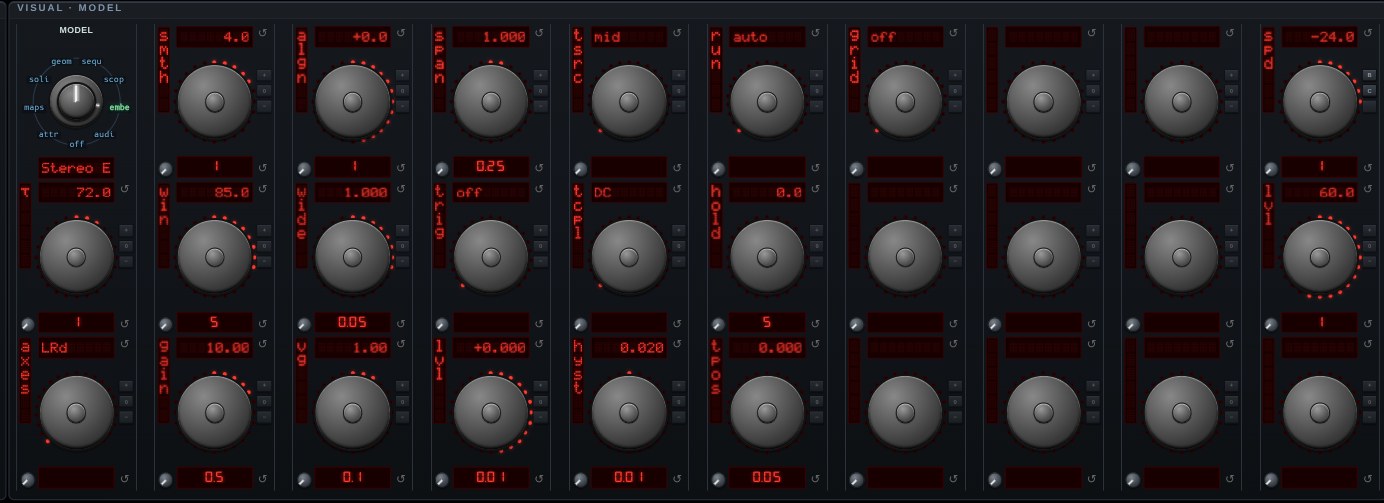
Stereo Embedding — the Takens trail built from the two channels instead of one channel's past. Takens' theorem manufactures the missing axes out of a signal's own history because there is only one signal; a stereo source has already measured two, so this mode plots them against each other and what you see is the real relationship between the channels — phase, polarity, correlation, width — rather than a reconstruction. Looked at head-on it is the goniometer (vectorscope) of a mastering desk, which is the XY Scope's figure; the third axis is what a scope with two deflection plates cannot give you.
AXES picks the assignment. L,R,L(t−τ) is the goniometer with a delay coordinate for depth: a tone that draws one ellipse edge-on unrolls into a helix, and τ still means what it means in the Takens mode. L,R,time sweeps the figure along a ribbon so successive cycles stack instead of overwriting — the only way to see a slow phase drift, which on a flat display just wobbles. The mid/side positions rotate the basis 45°: M=(L+R)/2 and S=(L−R)/2, so center content lies along one axis and difference content along the other and width is an extent rather than a tilt. τ is inert on the two time positions.
CORR is the correlation meter: +1.00 means the channels are identical and the figure is a diagonal line, 0 means they are unrelated and it is a round cloud, −1.00 means one is the other inverted (and the difference vanishes if the mix is summed to mono). A mono source reads "mono" and draws the diagonal, which is the correct picture of a signal with no stereo information in it — nothing here fakes a second channel out of a delayed copy of the first, because that delayed copy is exactly what this mode exists to stop pretending is a channel. The mid/side positions are the ones worth turning to then: S is zero and what is left is an honest two-coordinate delay embedding.
ALGN is an inter-channel DELAY, ±2 ms, and it is the fault a goniometer gets reached for: a spaced pair of microphones, a mis-clocked converter, a plugin reporting its latency wrong. An offset draws as a figure that opens into an ellipse and rotates as the frequency moves; dial the knob until the figure collapses back onto the diagonal and it reads how far apart the channels were. WIDE scales side against mid — the width control of a mid/side processor, applied to the drawing rather than to the audio, so it answers what widening would do and what would collapse if the result were summed to mono. Neither moves CORR, which goes on reading the source as it actually is.
WIN is how much time the figure spans, in milliseconds — a phase display is read over a few tens of them, past a couple of hundred it is a filled blob; GAIN sets how large a full-scale sample draws, and as in the Takens mode the scale is fixed and nothing auto-ranges.
Audio comes from the active source — the microphone, the signal generators, or a server feed. The feed asks the capture for the source as it was recorded, over the WebSocket and over WebTransport alike, so a stereo sink gives real stereo either way; a server or a device with only one channel to give reads "mono".
Open Stereo Embedding in chaosrack →It opens running, on the model selector, with its own knobs. Rotate it by dragging, zoom with the wheel, and turn the parameters to see what the figure does when the system changes.